

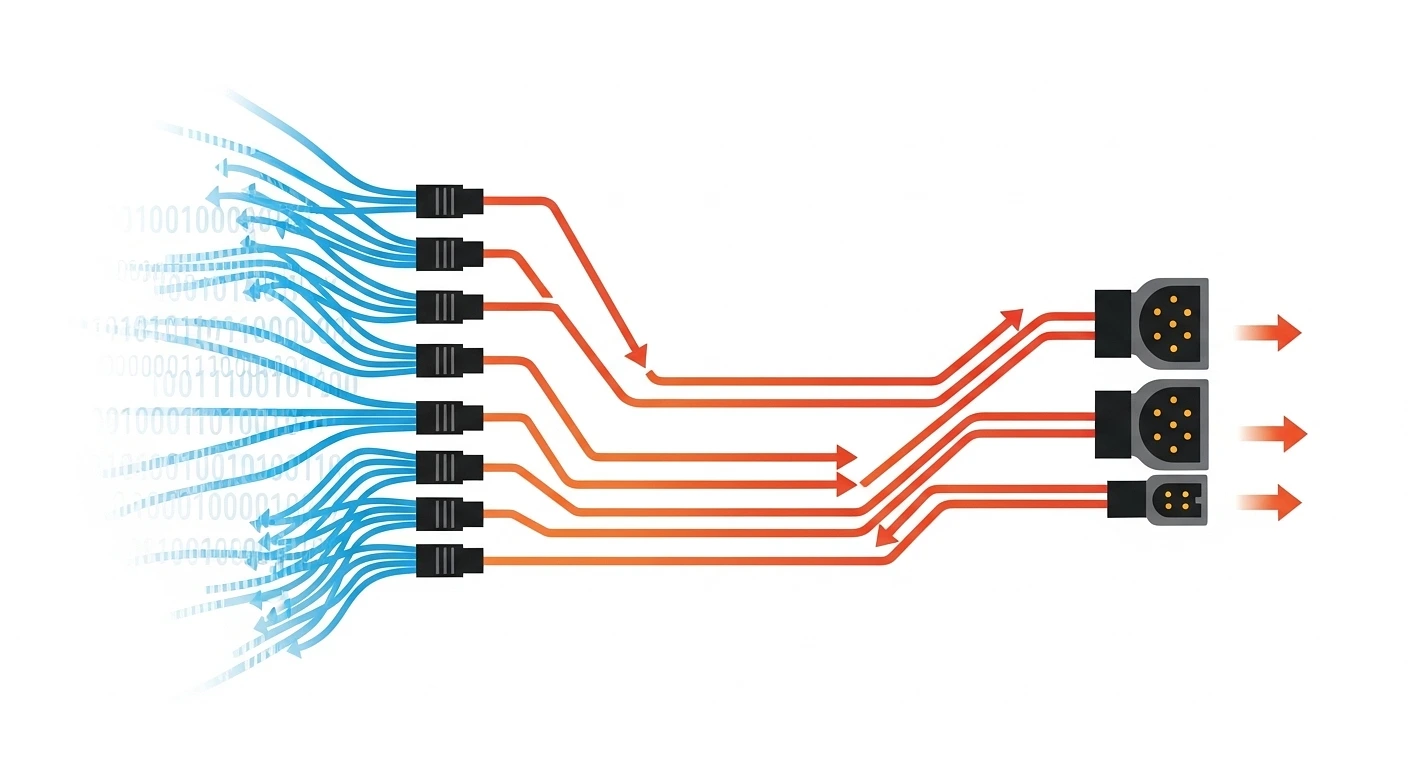

It’s hardly a secret that we live, today, in a highly interconnected world. Unsurprisingly, then, electrical connectors form the backbone of all manner of products and systems, encompassing the likes of office IT setups, smart homes, industrial automation, electric vehicles (EVs), data centres, and renewable energy infrastructure.
Moreover, far from being static, the landscape of industrial and consumer electronics is a rapidly evolving one.
This process of constant development and refinement has further driven up demand for high-performance connectors that can handle massive data rates and high power delivery.
The Fundamental Role of Power and Data Connectors in the UK
Focusing on the UK specifically, the Government is continuing its efforts to achieve net zero by the middle of this century. In accordance with this, massive investments are being made in offshore wind, EV infrastructure, smart cities, and 5G and edge computing.
Amid such an ongoing rush of innovations and projects, engineers are seeking out connectors that they can trust to handle higher currents, faster data rates, and more punishing environments, at the same time as remaining compact and energy efficient.
Are ‘Power Connectors’ And ‘Data Connectors’ Different Things?
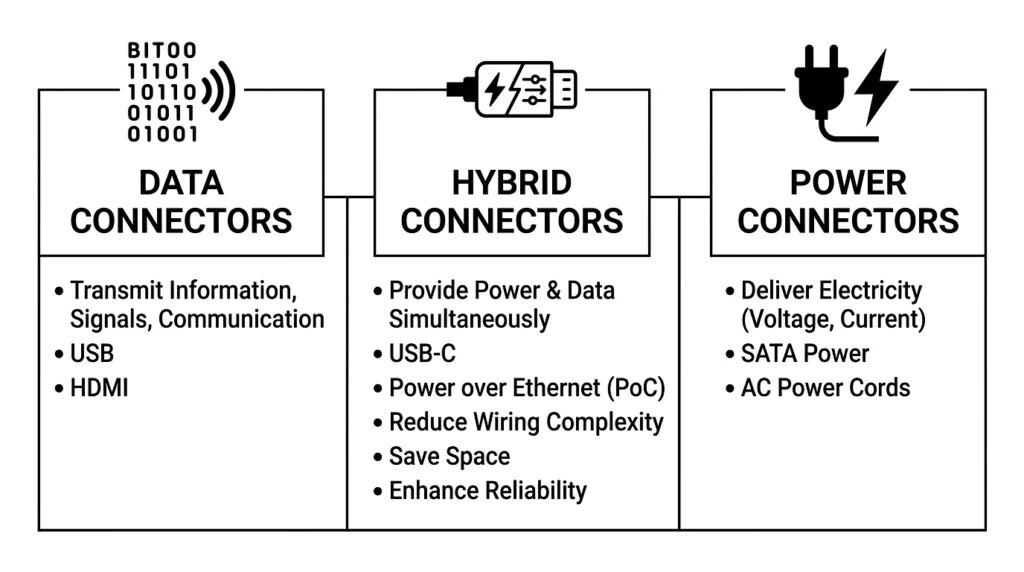
Broadly speaking, yes, a “power connector” is not the same thing as a “data connector”. These two types of connectors are primarily distinguished by their purpose, the signals they carry, and their design.
Specifically:
- Data connectors are used for transmitting information, signals, or communication between systems (examples include USB and HDMI)
- Power connectors are used to deliver electricity (voltage and current) to components (examples include SATA power or AC power cords).
It is also true, however, that some modern connectors are hybrid, with the ability to provide power and data simultaneously, as in the cases of USB-C or Power over Ethernet (PoC).
Hybrid connectors are strong sellers largely due to how they reduce wiring complexity, save space, and enhance reliability across such applications as renewable energy projects and EV charging.
Power Connectors: Delivering Safe and Efficient Electricity
We are aiming this article chiefly at readers in the UK. Nonetheless, much of this content will also be relevant for readers using power and data connectors elsewhere in the world.
Certainly, in countries like the UK, it is crucial for power connectors to incorporate safety features like earthing, fusing, and protection against overloads.
Common types of power connectors include BS 1363 (Type G) plugs and sockets. This is the standard UK 13A fused plug, with rectangular pins and shutters on sockets for household, commercial, and light industrial use.
IEC 60320 appliance couplers are also available, these seeing widespread use for IT equipment and power supplies.
Meanwhile, high-power industrial connectors are trusted for heavier loads. They include heavy-duty circular or rectangular types, rated for higher amperage and often IP67-rated for dust and water resistance.
Data Connectors: Enabling High-Speed Transmission
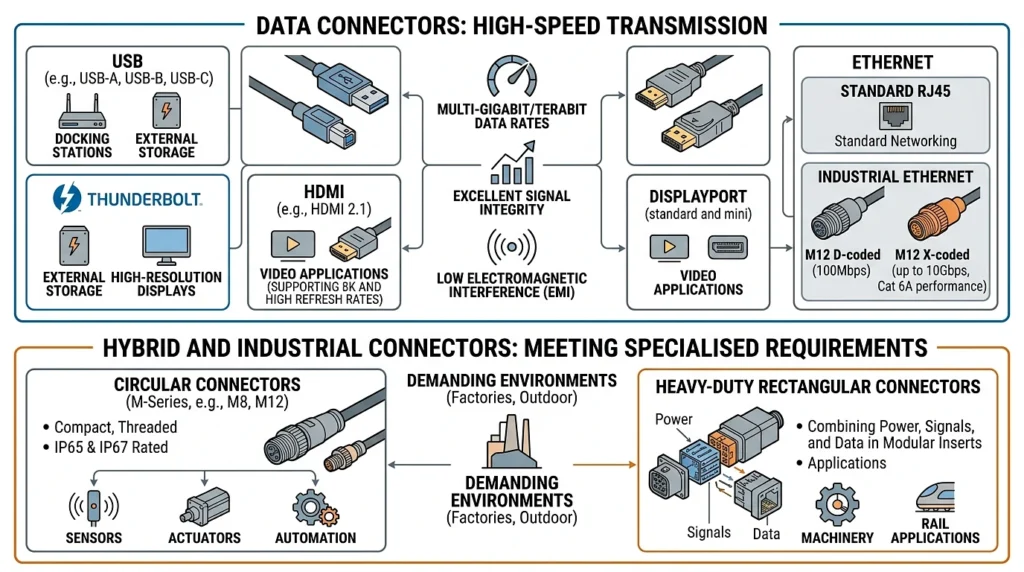
21st-century applications necessitate the use of connectors that support multi-gigabit or even terabit-level data rates.
Excellent signal integrity and low electromagnetic interference (EMI) will be further crucial priorities for anyone attempting to decide on the right data connectors for a given modern project.
In practice, then, engineers might turn to USB and Thunderbolt options. These see widespread use for docking stations, external storage, and high-resolution displays across offices and the creative industries in the UK.
HDMI and DisplayPort connectors, meanwhile, are extensively depended on for video applications, with HDMI 2.1 supporting 8K and high refresh rates.
Then, there are sought-after Ethernet connectors such as RJ45 for standard networking. Industrial environments favour M12 D-coded (100Mbps) or X-coded (up to 10Gbps) options for rugged Cat 6A performance.
- Hybrid And Industrial Connectors: Meeting Specialised Requirements
In demanding environments such as factories and outdoor renewable installations, circular connectors deliver impressive outcomes.
Examples of these components include M8 and M12 series connectors, encompassing compact, threaded, IP65 and IP67-rated offerings for sensors, actuators, and automation.
Heavy-duty rectangular connectors are commonly used, too, for combining power, signals, and data in modular inserts. These connectors are an excellent match for machinery and rail applications.
The Right Connectors Do More Than Simply Create Connections
High-performance power and data connectors might seem like small components, but they underpin the reliable and efficient systems that power so much infrastructure in countries like the UK. That encompasses such elements as home offices, data centres, wind farms, and autonomous vehicles.
It is, then, well worth investing in genuinely high-quality and standards-compliant connectors to help ensure the best possible safety, performance, and futureproofing in your own projects.